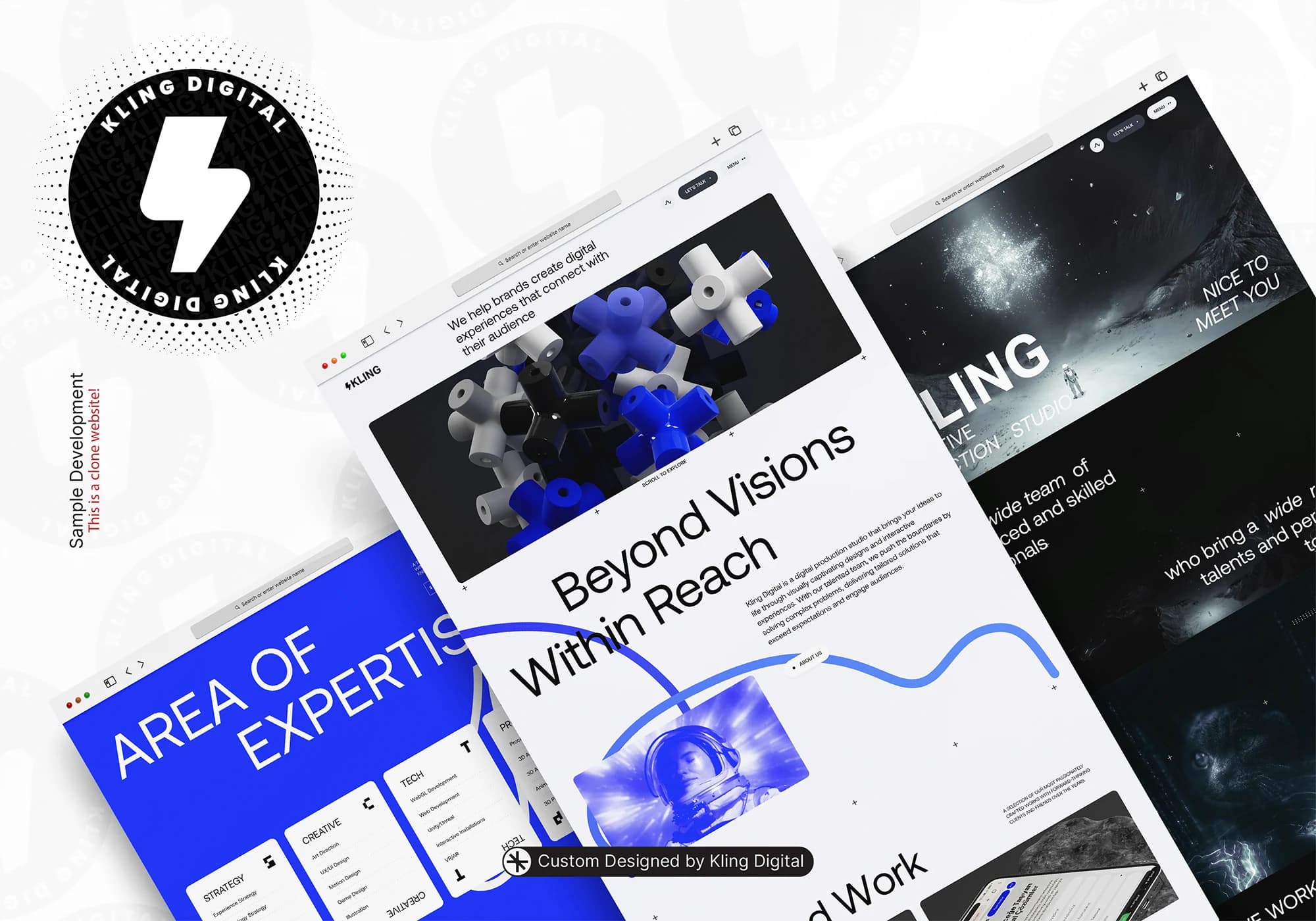
Kling Digital Creative Studio (app.klingdigital.com) is an interactive spatial web engineering showcase uniting real-time 3D WebGL physics simulation, refractive particle choreography, and kinetic typography to demonstrate immersive brand storytelling on the modern web.
Executive Project Summary
Pre-staged via a progressive 000–100 GPU asset loader, the experience combines a cursor- and scroll-reactive 3D physics playground, ambient audio toggle controls, an embedded interactive showreel, and a scroll-locked 3D astronaut glass-shatter sequence running smoothly in browser viewports.
Engineering 60 FPS Real-Time 3D Physics and Spatial Motion
Delivering interactive rigid-body collisions and refractive 3D materials without frame drops requires disciplined geometry instancing, shader optimization, and inertia scroll synchronization.
Architected with Enterprise Next.js Engineering and Interactive UI/UX Design, runtime responsiveness was benchmarked via our Speed Analyzer.
WebGL Rigid-Body Playground, Glass-Shatter Sequence, and Curated Grid
- Interactive Hero 3D Physics Canvas: Glossy black, matte white, and electric blue 3D connectors respond dynamically to pointer velocity, collisions, and scroll inertia.
- Scroll-Triggered 3D Shatter Choreography: An astronaut emerges through a fracturing tablet screen rendered with refractive crystal shards and cyan light ribbons.
- Smooth Inertia Scroll, Kinetic Type & Audio Pill: Custom momentum scrolling paired with staggered character reveals and a header sound-wave toggle.
- 12-Project Spatial Showcase Grid: Two-column interactive portfolio matrix spanning AI interfaces, automotive 3D motion, spatial computing, and AR experiences.
| Technical Layer | Static Video-Background Websites | Kling Digital 3D WebGL Studio Engine |
|---|---|---|
| Visual Interactivity | Passive looped MP4 background video | Real-time cursor- and collision-driven 3D WebGL rigid-body physics |
| Narrative Progression | Linear vertical section jumps | Scroll-linked 3D camera choreography, crystal shatter particles, and kinetic type |
| Asset Pipeline | Unbuffered heavy media stalls | GPU-staged progressive loader with instanced PBR materials |
Delivered Engineering Value
The platform serves as a live production benchmark for flagship product launches, immersive 3D brand worlds, and high-impact interactive campaigns.
Bespoke 3D WebGL & Spatial Brand Launches
Planning an interactive 3D product reveal or spatial web experience? Connect with Kling Digital engineers.