
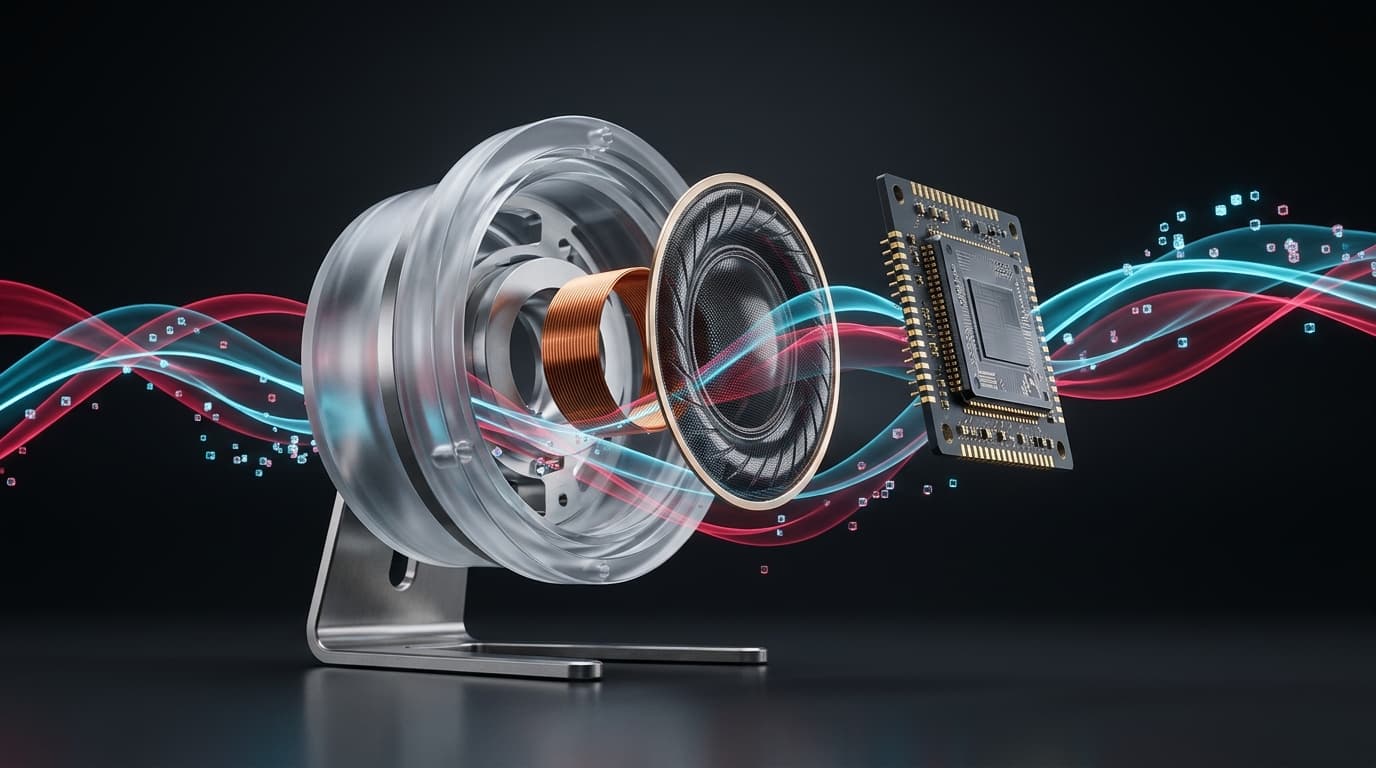
Every week, audiophiles and mobile product teams confront the same acoustic paradox: you subscribe to a 24-bit / 96 kHz Hi-Res lossless tier on Apple Music, Tidal, or Qobuz—or engineer a real-time media application—yet the moment the audio stream crosses a wireless headphone connection, fine spatial transients flatten and lip-sync latency creeps past 180 milliseconds. The culprit is rarely the headphone's physical driver or onboard Digital-to-Analog Converter (DAC); it is the Bluetooth Audio Codec governing the radio frequency (RF) bottleneck.
Bluetooth audio codecs—led by Sony LDAC (up to 990 kbps), Qualcomm aptX Lossless (up to 1,200 kbps), Apple AAC (256 kbps), and Bluetooth LE Audio LC3—are real-time digital signal processing (DSP) algorithms that compress raw PCM audio to fit inside the narrow 2.4 GHz Bluetooth radio link. For pure high-resolution bandwidth on Android, LDAC and aptX Lossless deliver the highest acoustic fidelity, whereas AAC dominates on Apple iOS via hardware-accelerated CoreAudio encoding, and LC3 leads low-latency (20–35 ms) wireless transport. When architecting media platforms via our Custom Software & Media Engineering Services or auditing streaming delivery payloads with our Performance & Core Web Vitals Analyzer, understanding this RF transport layer is mandatory.
Executive Engineering Summary (Key Takeaways)
- The A2DP Bandwidth Ceiling: Uncompressed Red Book CD audio (16-bit / 44.1 kHz stereo) requires 1,411.2 kbps, and 24-bit / 96 kHz studio masters demand 4,608 kbps—far exceeding the 300 to 1,200 kbps usable payload of Bluetooth Classic (BR/EDR) in the 2.4 GHz ISM band.
- Platform-Specific Winners: On compatible Android hardware, aptX Lossless (1,200 kbps) and Sony LDAC (990 kbps) provide the highest dynamic range; on iPhone, iPad, and Mac, Apple's hardware CoreAudio AAC (256 kbps) encoder achieves perceptual transparency up to 20 kHz.
- The LE Audio Shift: Bluetooth 5.2/5.3 LC3 (Low Complexity Communications Codec) outperforms legacy SBC at half the bitrate (160 kbps vs. 345 kbps) while cutting glass-to-glass latency down to 20–35 ms over Isochronous Channels (ISOC).
1. Psychoacoustic Compression vs. Sub-Band Coding Architectures
An uncompressed Linear Pulse-Code Modulation (LPCM) CD stream calculates to exactly 1,411.2 kbps (44,100 × 16 × 2). Because the Bluetooth Advanced Audio Distribution Profile (A2DP) must survive packet framing overhead, Automatic Repeat Request (ARQ) retransmissions, and strict battery envelopes, wireless codecs rely on three distinct mathematical paradigms to compress the signal:
- Time-Domain Sub-Band Coding & ADPCM (SBC, Classic aptX, aptX HD): Splits the audio spectrum into discrete frequency sub-bands using quadrature mirror filter banks and quantizes sample differences via Adaptive Differential Pulse-Code Modulation (ADPCM). This approach consumes minimal CPU cycles and achieves low algorithmic latency, but at lower bitrates it can expose quantization noise floors across high-frequency transients.
- Psychoacoustic Modeling & MDCT (AAC, LC3): Exploits human cochlea perception limits. Using Simultaneous Frequency Masking and Temporal Masking paired with a Modified Discrete Cosine Transform (MDCT), the encoder permanently discards frequency components that the human ear cannot perceive beside louder dominant tones. This delivers remarkable perceptual transparency at 256 kbps, though the transform window adds encoding buffer delay.
- Hybrid Sub-Band / Dynamic Bit Allocation (Sony LDAC, LHDC): Combines sub-band decomposition with variable frame quantization scaling up to 990 kbps, preserving ultrasonic frequency extension up to 40 kHz for 24-bit / 96 kHz masters.

2. Comprehensive Technical Comparison Matrix of Bluetooth Codecs
The engineering reference matrix below compares all production Bluetooth audio codecs across maximum bit depth, sample rate, bitrate allocation, end-to-end latency, and operating system support:
| Codec | Max Bit Depth / Sample Rate | Bitrate Range | Typical End-to-End Latency | OS & Hardware Ecosystem |
|---|---|---|---|---|
| SBC (Sub-Band Coding) | 16-bit / 48 kHz | 192 – 328 kbps (SBC XQ: 551 kbps) | 150 – 220 ms | Universal mandatory baseline codec across every A2DP Bluetooth device globally. |
| AAC (Advanced Audio Coding) | 24-bit / 48 kHz | 128 – 256 kbps (CBR / VBR) | 160 – 240 ms | Native flagship codec for Apple iOS / macOS; broadly supported on Android. |
| Qualcomm aptX | 16-bit / 48 kHz | 352 kbps (4:1 fixed ADPCM) | 120 – 160 ms | Qualcomm Snapdragon Android devices, Windows 10/11; unsupported on iOS. |
| Qualcomm aptX HD | 24-bit / 48 kHz | 576 kbps (4:1 fixed ADPCM) | 130 – 170 ms | Android smartphones and audiophile wireless headphones/DACs. |
| aptX Adaptive & Lossless | 24-bit / 96 kHz (Lossless: 16/44.1) | 279 – 420 kbps (Lossless: 1,100 – 1,200 kbps) | 50 – 80 ms (Gaming mode) | Snapdragon Sound certified Android flagships and next-gen earbuds. |
| Sony LDAC | 24-bit / 96 kHz | 330 / 660 / 990 kbps (3 stepped tiers) | 150 – 230 ms | Native in Android 8.0+ AOSP kernel; wide audiophile headphone adoption; no iOS support. |
| LC3 / LC3plus (LE Audio) | 24-bit / 48 kHz (LC3plus: 96 kHz) | 160 – 345 kbps (LC3plus: 500+ kbps) | 20 – 35 ms | Bluetooth 5.2+ / 5.3+ LE Audio devices on Android 13+, Windows 11, and Auracast hardware. |
3. Deep-Dive Architectural Analysis of Production Codecs
A. Sony LDAC: 990 kbps Hi-Res Throughput vs. 2.4 GHz RF Stability
Developed by Sony LDAC and contributed directly into the Android Open Source Project (AOSP) stack starting with Android 8.0, LDAC remains the most widely accessible high-resolution codec capable of nearly tripling standard Bluetooth bandwidth. Crucially, LDAC does not scale along a continuous curve; instead, it negotiates one of three fixed discrete profiles:
- Audio Quality Priority Mode (990 kbps at 48/96 kHz; 909 kbps at 44.1/88.2 kHz): Delivers bit-transparent reconstruction across the audible spectrum with a measurably lower noise floor than 16-bit CD audio. However, pushing nearly 1 Mbps over Bluetooth Classic makes the link sensitive to multipathing and 2.4 GHz Wi-Fi congestion.
- Standard Normal Mode (660 kbps / 606 kbps): The balanced operational sweet spot delivering clean high-frequency extension with robust packet error resilience.
- Connection Priority Mode (330 kbps / 303 kbps): Emergency fallback tier under heavy RF interference; at 330 kbps, LDAC exhibits steeper high-frequency roll-off than a well-implemented 256 kbps AAC encoder.
Android Developer Configuration: Locking True 990 kbps LDAC
Most Android smartphones default LDAC to Best Effort (Adaptive) mode, which silently locks the link at 660 kbps or 330 kbps. To force true 990 kbps transmission, open Settings > Developer Options > Bluetooth Audio LDAC Codec: Playback Quality and select Optimized for Audio Quality (990 kbps / 909 kbps). Additionally, keep your smartphone connected to 5 GHz or 6 GHz (Wi-Fi 6E/7) bands so the 2.4 GHz spectrum remains dedicated to Bluetooth A2DP packets.
B. Qualcomm aptX Adaptive and aptX Lossless
To unify the fragmented legacy lineup of classic aptX, aptX HD, and aptX Low Latency, Qualcomm engineered aptX Adaptive as part of the Snapdragon Sound ecosystem. Rather than stepping abruptly between three rigid tiers like LDAC, aptX Adaptive continuously monitors surrounding RF noise and device playback context (music streaming vs. real-time gaming) to dynamically scale bitrates between 279 kbps and 420 kbps—delivering perceptual quality equivalent to aptX HD (576 kbps) with zero audio dropouts. On certified hardware, aptX Lossless extends this pipeline up to 1,200 kbps under clean RF conditions to deliver mathematically bit-for-bit lossless 16-bit / 44.1 kHz CD audio.
C. Why AAC Sounds Exceptional on Apple iOS but Inconsistent on Android
Apple exclusively utilizes AAC across iPhone, iPad, Mac, and AirPods hardware, bypassing aptX and LDAC entirely. In objective acoustic measurements, Apple's hardware-accelerated iOS CoreAudio AAC encoder achieves near-transparent frequency response up to 20 kHz at 256 kbps. Conversely, several mid-range Android OEM implementations rely on software AAC encoders configured with conservative CPU budgets that impose a hard low-pass filter around 14.5–15.5 kHz. Consequently, the exact same AAC headphones can sound crisp and spacious on iOS while sounding noticeably veiled on certain Android builds.
D. LC3 and Bluetooth LE Audio: Sub-30ms Latency and Auracast
Introduced alongside Bluetooth 5.2/5.3, the Bluetooth LE Audio architecture replaces the aging SBC baseline with LC3 (Low Complexity Communications Codec). Blind listening tests conducted by the Bluetooth SIG demonstrate that LC3 at just 160 kbps outperforms SBC at 345 kbps while cutting radio transceiver power draw nearly in half. Furthermore, LE Audio utilizes Isochronous Channels (ISOC) to transmit independent, time-synchronized streams to the left and right earbuds simultaneously, dropping end-to-end latency down to 20–35 ms and unlocking Auracast multi-receiver broadcast audio.
4. Audio Streaming & WebRTC Optimization for Mobile and Web Applications
When architecting media streaming platforms, WebRTC communication suites, or high-performance web applications through our Enterprise Next.js & Web Engineering practice, the single most destructive anti-pattern degrading Bluetooth playback is Double Lossy Transcoding (Generation Loss).
Critical Architecture Pitfall: Double Lossy Transcoding (Generation Loss)
When a web or mobile application streams low-bitrate 128 kbps MP3 audio, the client OS decodes that MP3 into raw PCM and immediately re-encodes it into lossy AAC or SBC for Bluetooth A2DP transmission. Cascading two different psychoacoustic masking models compounds quantization noise, metallic pre-echo artifacts, and phase smearing. Always serve master streams in AAC-LC (256 kbps), Opus (160–256 kbps), or lossless FLAC / ALAC (via HLS/DASH).
In browser-based interactive audio, WebRTC voice rooms, and cloud gaming applications, engineers should verify hardware decoding efficiency via the W3C Web Audio API and MediaCapabilities interface, initialize the AudioContext at 48000 Hz to bypass OS mixer resampling (Android AudioFlinger / Windows WASAPI), and patch WebRTC Opus SDP parameters (RFC 7587) as shown below:
interface BluetoothAudioPipelineConfig {
  preferredSampleRate: 44100 | 48000;
  targetBitrateBps: number;
  enableInbandFec: boolean;
}

/**
 * Initializes a hardware-aligned Web Audio API context at 48 kHz
 * to bypass OS mixer Sample Rate Conversion (Android AudioFlinger / Windows WASAPI).
 */
export async function createLowLatencyAudioContext(
  config: BluetoothAudioPipelineConfig = {
    preferredSampleRate: 48000,
    targetBitrateBps: 256000,
    enableInbandFec: true,
  }
): Promise<AudioContext> {
  if (typeof window !== "undefined" && "mediaCapabilities" in navigator) {
    const capability = await navigator.mediaCapabilities.decodingInfo({
      type: "file",
      audio: {
        contentType: 'audio/mp4; codecs="mp4a.40.2"', // AAC-LC master stream
        channels: "2",
        bitrate: config.targetBitrateBps,
        samplerate: config.preferredSampleRate,
      },
    });

    if (!capability.powerEfficient) {
      console.warn("[AudioPipeline] Hardware AAC decoding unavailable; falling back to PCM buffer alignment.");
    }
  }

  return new AudioContext({
    latencyHint: "interactive",
    sampleRate: config.preferredSampleRate, // Matches native 48 kHz DSP clock of Bluetooth A2DP/LE chips
  });
}

/**
 * Optimizes WebRTC SDP Answer (RFC 7587) to prevent double lossy transcoding degradation
 * over wireless Bluetooth A2DP & LE Audio (LC3) endpoints.
 */
export function patchOpusSdpForBluetoothFidelity(sdp: string, maxBitrateBps = 256000): string {
  return sdp.replace(
    /a=fmtp:111 (.*)/g,
    `a=fmtp:111 $1;stereo=1;sprop-stereo=1;maxaveragebitrate=${maxBitrateBps};useinbandfec=1;cbr=0`
  );
}
Locking the hardware clock at 48000 Hz and enabling Opus in-band Forward Error Correction (useinbandfec=1) prevents real-time Sample Rate Conversion (SRC) phase distortion while preserving clean spectral headroom for downstream Bluetooth DSP chips. If you are planning a custom audio, WebRTC, or low-latency SaaS platform, you can estimate your engineering scope instantly with our Interactive Project Cost Calculator.