

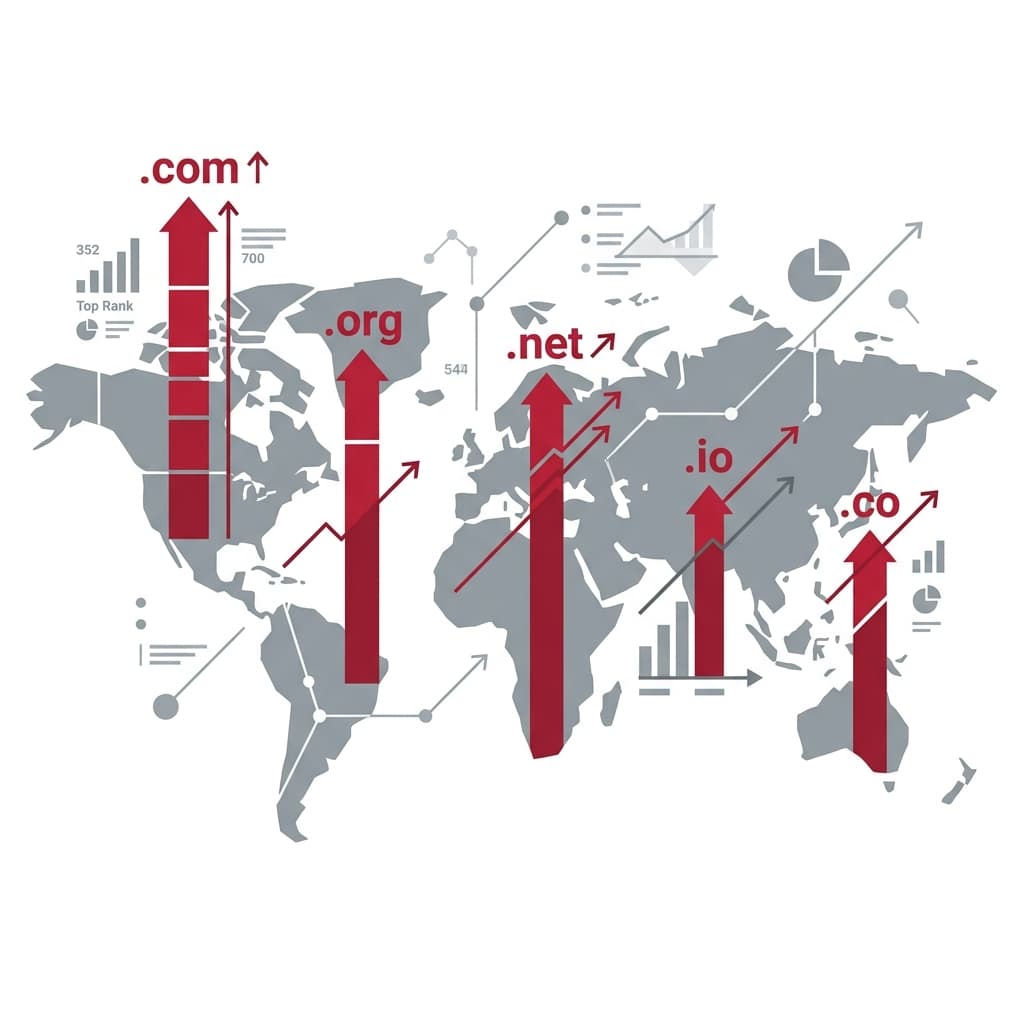
For digital platforms operating across multiple markets or engineering multi-locale growth, selecting a Top-Level Domain (TLD) is far more than a branding exercise. It is a foundational systems architecture decision that governs search engine crawl budget allocation, link equity consolidation, TLS/DNS edge latency, and international indexation topology. Search engine ranking systems do not evaluate domain extensions through superficial keyword matching in the suffix; instead, they classify the extension's geopolitical assignment (ccTLD vs. gTLD), verify cross-locale hreflang reciprocity, and measure host resolution stability.
Important
Google Search ranking algorithms do not assign an inherent ranking bonus to any specific generic top-level domain (gTLD). From an algorithmic baseline, .com, .io, .ai, .org, and .tech start on equal footing. Conversely, country-code top-level domains (ccTLDs such as .de, .co.uk, .fr, or .com.tr) act as hard geographical locks that boost visibility within the designated nation while restricting organic reach in outside markets.
1. Algorithmic Classification of Top-Level Domains
Within the IANA Root Zone Database, search engines categorize domain extensions into three distinct operational classes, each triggering different indexation and geotargeting rules in the search pipeline:
Generic Top-Level Domains (gTLDs and New nTLDs)
Legacy extensions (.com, .net, .org) and expanded generic extensions (.cloud, .digital, .software, .agency) are treated as geographically neutral. Search engines impose no national boundary on these domains; instead, regional relevance is computed dynamically from document language declarations, hreflang clusters, structured data (such as local Organization addresses), and regional backlink graphs. Including an industry keyword in a new gTLD (for instance, brand.law or brand.finance) does not trigger an exact-match ranking multiplier in modern semantic search, though it can clarify URL context for human users scanning SERP snippets.
Country-Code Top-Level Domains (ccTLDs)
Two-letter extensions defined by the ISO 3166-1 alpha-2 standard (such as .de for Germany, .jp for Japan, .fr for France, or .com.tr for Turkey) serve as the strongest possible automated geotargeting signal. When a platform is deployed on a ccTLD, search engines explicitly bind its indexation weight to users querying from that jurisdiction. While this provides an immediate local relevance advantage in domestic SERPs, it creates a structural ceiling when the enterprise attempts to rank the same domain for international queries in other countries.
Generic Country-Code Top-Level Domains (gccTLDs)
Certain two-letter country extensions have been adopted so broadly by the global technology sector that search engines override their ISO geographical binding and classify them as generic TLDs (gccTLDs). Prominent examples include .io (British Indian Ocean Territory), .ai (Anguilla), .co (Colombia), .me (Montenegro), and .tv (Tuvalu). Because Google processes gccTLDs identically to .com, software and AI enterprises using .ai or .io can deploy global subfolder architectures without suffering unintended geographic confinement.
2. International URL Architecture: ccTLDs vs. Subfolders vs. Subdomains
When architecting a multi-language platform, engineering and SEO leaders must choose between maintaining an array of localized ccTLDs, consolidating all locales under a single gTLD using subfolders (example.com/de/, example.com/fr/), or splitting regions across subdomains (de.example.com). The matrix below evaluates each topology across technical SEO and infrastructure criteria:
| Architectural Dimension | Single gTLD + Subfolders (example.com/de/) | Independent ccTLD Network (example.de, example.fr) | Subdomain Topology (de.example.com) | gccTLD + Subfolders (example.io/de/) |
|---|---|---|---|---|
| Link Equity Consolidation | Maximum: Backlinks earned in any language compound root domain authority | Fragmented: Every country domain must build authority from zero independently | Moderate: Search systems may partition authority across distinct hostnames | Maximum: Root authority flows seamlessly across all regional subdirectories |
| Geotargeting Signal Strength | Driven by hreflang, localized content, and regional citations | Automatic and rigid (native country-level binding) | Requires explicit hreflang and regional signal reinforcement | Full global flexibility governed by hreflang clusters |
| Crawl Budget Efficiency | Unified host queue with high crawl efficiency and rapid discovery | Separate crawl allocation per domain; slower discovery on newer ccTLDs | Separate DNS lookups and partitioned crawler scheduling per host | Unified host queue with rapid multi-locale indexing |
| DNS, TLS & Edge Overhead | Low: Single TLS certificate, unified CDN cache pool, centralized WAF | Very High: Multi-registrar renewals, separate DNS zones, distinct TLS handshakes | Moderate: Requires wildcard TLS certificates and separate DNS records | Low: Centralized edge caching and single TLS termination |
| Engineering Governance | Unified deployment pipeline (e.g., Next.js App Router i18n routing) | Complex cross-domain session state, CORS headers, and cookie isolation | Cross-subdomain state synchronization and analytics deduplication | Unified codebase and single analytics property |
Tip
For multi-locale B2B, SaaS, and enterprise service platforms, the Single gTLD + Subfolder (example.com/en/, example.com/de/, example.com/tr/) topology consistently delivers the highest organic ROI. A high-authority editorial backlink pointing to an English research article immediately elevates the domain rating that supports your German, Spanish, and French commercial landing pages.
3. Hreflang Topology and Cross-Locale Signal Reciprocity
Regardless of whether you deploy a single gTLD with subfolders or a federation of ccTLDs, the hreflang specification is the mandatory deterministic protocol for mapping language and regional variants. Following Google's deprecation of the legacy International Targeting country selector in Search Console, automated locale resolution relies entirely on reciprocal hreflang annotations, document language attributes, and localized content signals.
Below is a production-grade hreflang implementation for a six-locale enterprise deployment:
<!-- Complete Reciprocal Hreflang Cluster for Multi-Locale Architecture -->
<link rel="alternate" hreflang="en-US" href="https://example.com/en/enterprise-seo-architecture" />
<link rel="alternate" hreflang="tr-TR" href="https://example.com/tr/kurumsal-seo-mimarisi" />
<link rel="alternate" hreflang="de-DE" href="https://example.com/de/unternehmens-seo-architektur" />
<link rel="alternate" hreflang="fr-FR" href="https://example.com/fr/architecture-seo-entreprise" />
<link rel="alternate" hreflang="es-ES" href="https://example.com/es/arquitectura-seo-empresarial" />
<link rel="alternate" hreflang="ar-SA" href="https://example.com/ar/enterprise-seo-architecture" />
<link rel="alternate" hreflang="ru-RU" href="https://example.com/ru/enterprise-seo-architecture" />
<link rel="alternate" hreflang="x-default" href="https://example.com/en/enterprise-seo-architecture" />
Non-Negotiable Engineering Rules for Hreflang Clusters
- Strict Bidirectional Reciprocity: If URL A declares URL B as its
de-DEalternate, URL B must explicitly declare URL A as its corresponding alternate. Unidirectional tags are discarded during indexation. - Self-Referencing Canonical Alignment: Every localized URL must contain a self-referencing
pointing to itself, never to the default English URL. Pointing a localized page's canonical tag to another language version instructs crawlers to de-index the translated page. - HTTP Response Status Integrity: Every URL inside an
hreflangcluster must resolve with a direct200 OKstatus code. Including301redirects or404endpoints insidehreflangmatrices corrupts cluster validation.
4. DNS Resolution Latency, Registry Infrastructure, and Trust Signals
While the text of a TLD does not alter ranking equations directly, the underlying registry infrastructure and DNS security posture influence both crawl efficiency and user experience metrics:
- TLD Registry Anycast Performance: Tier-1 registries operating
.comand.netutilize dense global Anycast DNS constellations with sub-20ms query resolution and 100% SLA availability. Conversely, certain under-provisioned regional ccTLD registries exhibit higher DNS lookup latency (150ms–300ms+) for international requests, directly inflating Time to First Byte (TTFB) for global crawlers and users. - Cryptographic Domain Trust (DNSSEC, CAA, and HSTS): Enterprise domains should enforce DNSSEC signing at the registrar level, publish explicit
CAArecords restricting which Certificate Authorities can issue TLS certificates, and register on the browser HSTS Preload list. - Anti-Abuse Reputation & Email Deliverability: Low-cost or historically abused nTLDs (such as certain bulk-registered promotional extensions) frequently suffer from systemic blocklisting across enterprise spam filters (Spamhaus, Barracuda). Even if Google indexes the site normally, poor domain reputation degrades transactional email deliverability and lowers organic Click-Through Rates (CTR) due to user unfamiliarity.
; Enterprise DNS Security & Authority Records
example.com.    3600    IN    CAA     0 issue "letsencrypt.org"
example.com.    3600    IN    CAA     0 issuewild "digicert.com"
example.com.    3600    IN    TXT     "v=spf1 include:_spf.google.com -all"
5. TLD Migration and Domain Consolidation Protocol
When consolidating multiple regional ccTLDs into a unified global .com architecture—or rebranding from an initial startup extension to an enterprise gTLD—follow a strict zero-loss migration protocol:
- Deterministic 1:1 Edge Redirects: Map every legacy URL to its exact semantic counterpart on the destination domain using a single-hop
HTTP 301 Moved Permanentlyresponse at the CDN edge. Never bulk-redirect deep content URLs to the destination homepage, which triggers Soft 404 classification and forfeits page-level rankings. - Eliminate Multi-Hop Redirect Chains: Ensure requests to
http://legacy.co.uk/pageresolve directly tohttps://global.com/en-gb/pagein a single hop without intermediate protocol or trailing-slash hops. - Long-Term Legacy Domain Retention: Maintain registrar ownership, active DNS resolution, and valid TLS certificates on all retired domains for a minimum of 24 to 36 months so historical external backlinks continue passing equity over HTTPS.
6. Executive Decision Checklist for TLD Selection
- Choose a single authoritative gTLD (
.com) with localized subfolders whenever your roadmap includes serving two or more countries or languages, ensuring every backlink strengthens the entire enterprise. - Reserve country-code TLDs (ccTLDs) for strictly single-country regulatory environments or as defensive 301 redirect aliases protecting your trademark in key local markets.
- Vet gccTLDs (
.ai,.io) carefully for long-term registry renewal economics and ensure full DNSSEC and Anycast support before committing production infrastructure.