shadcn/ui redefines frontend engineering by providing an open-source design system foundation that transfers accessible Radix UI primitives and Tailwind CSS utility classes directly into your application codebase rather than distributing them as an external npm package. By granting teams absolute code ownership, eliminating version lock-in, and providing unrestricted customizability, it fundamentally modernizes enterprise UI standards.
Engineering Summary
Components are added directly to your repository via CLI rather than living as a monolithic node_modules artifact. WAI-ARIA keyboard navigation and screen-reader compliance are provided out of the box through Radix UI primitives. The theme engine leverages Tailwind CSS v4 and standard CSS custom properties, enabling surgical control over design tokens.
Why It Stood Out: Real Production Context
In conventional web development, teams adopting monolithic UI frameworks such as MUI, Ant Design, or Chakra UI frequently found themselves trapped in complex style override patterns. Altering a single DOM node inside a third-party modal required hundreds of lines of brittle CSS hacks, and major package upgrades introduced breaking changes across entire platforms. shadcn/ui inverted this paradigm: with a philosophy of copying and owning the code instead of installing an external dependency, the actual source files live in your project. Engineering teams build bespoke design systems directly on native code rather than fighting third-party abstractions.
Under the Hood: Architecture, Interaction, and Tech Stack
The core architecture of shadcn/ui is established on Radix UI Primitives, Lucide Icons, class-variance-authority (CVA), and Tailwind CSS. The CLI functions not as a package manager, but as a distributed registry client. When a component is requested, the corresponding TypeScript source file and associated styling rules are written directly to your components/ui directory. This approach integrates seamlessly with React Server Components (RSC) during Next.js development executed by the Kling Digital team.
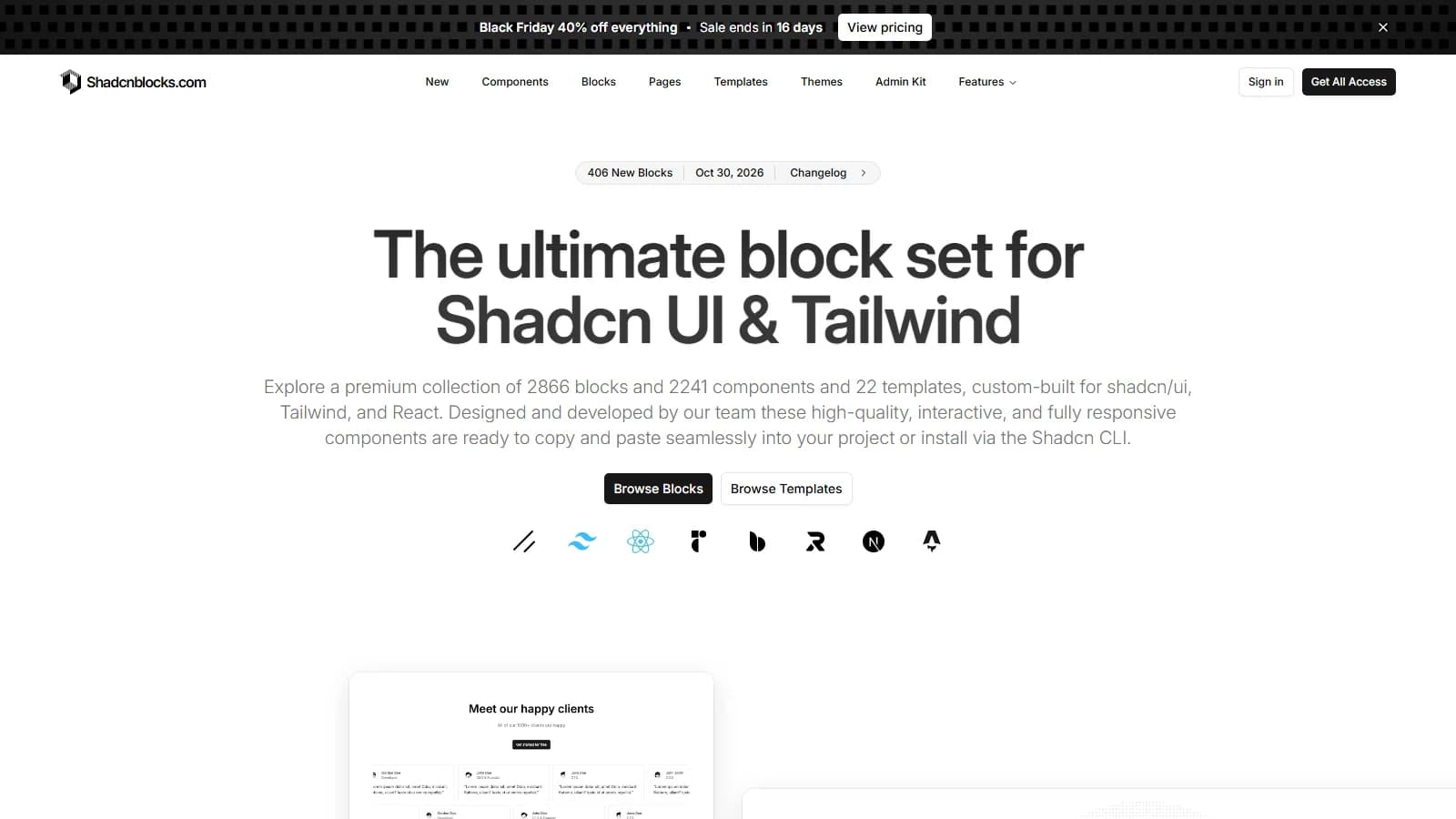
Minimizing external client-side JavaScript libraries directly enhances Core Web Vitals; to validate this impact on performance, analyze your application DOM depth using our speed tester. When projects require more extensive layouts, ecosystem extensions like those highlighted in our Shadcnblocks analysis demonstrate how third-party registries integrate natively into the exact same foundational architecture.
| Evaluation Metric | Traditional npm Libraries | shadcn/ui Approach |
|---|---|---|
| Code Ownership | Locked inside node_modules with rigid APIs | Fully open, editable source code in your repository |
| Accessibility (A11y) | Manual ARIA tagging and custom focus traps | Automated WAI-ARIA compliance via Radix UI primitives |
| Bundle Overhead | Unused component logic frequently leaks into bundle | Zero dead-code bloat; imports only components added to project |
| Styling Flexibility | Fragile !important rules and theme overrides | Direct utility-level control via Tailwind CSS and CVA |
When to Adopt vs. When to Avoid
shadcn/ui represents the most practical foundation for long-lifecycle SaaS platforms, dedicated product teams constructing proprietary design systems, and enterprise applications powered by Next.js. Because developers maintain complete ownership over the code, vendor lock-in is non-existent. However, for large teams maintaining hundreds of screens who prefer automatic single-click synchronization via npm and choose not to maintain component-level code locally, local maintenance can introduce ongoing operational overhead.
Kling Digital Architectural Note
Rather than leaving imported primitives scattered under components/ui, restructure them according to your own atomic design hierarchy. Align CVA configuration schemas with your organization design tokens to manage corporate typography and palettes through centralized CSS custom properties.