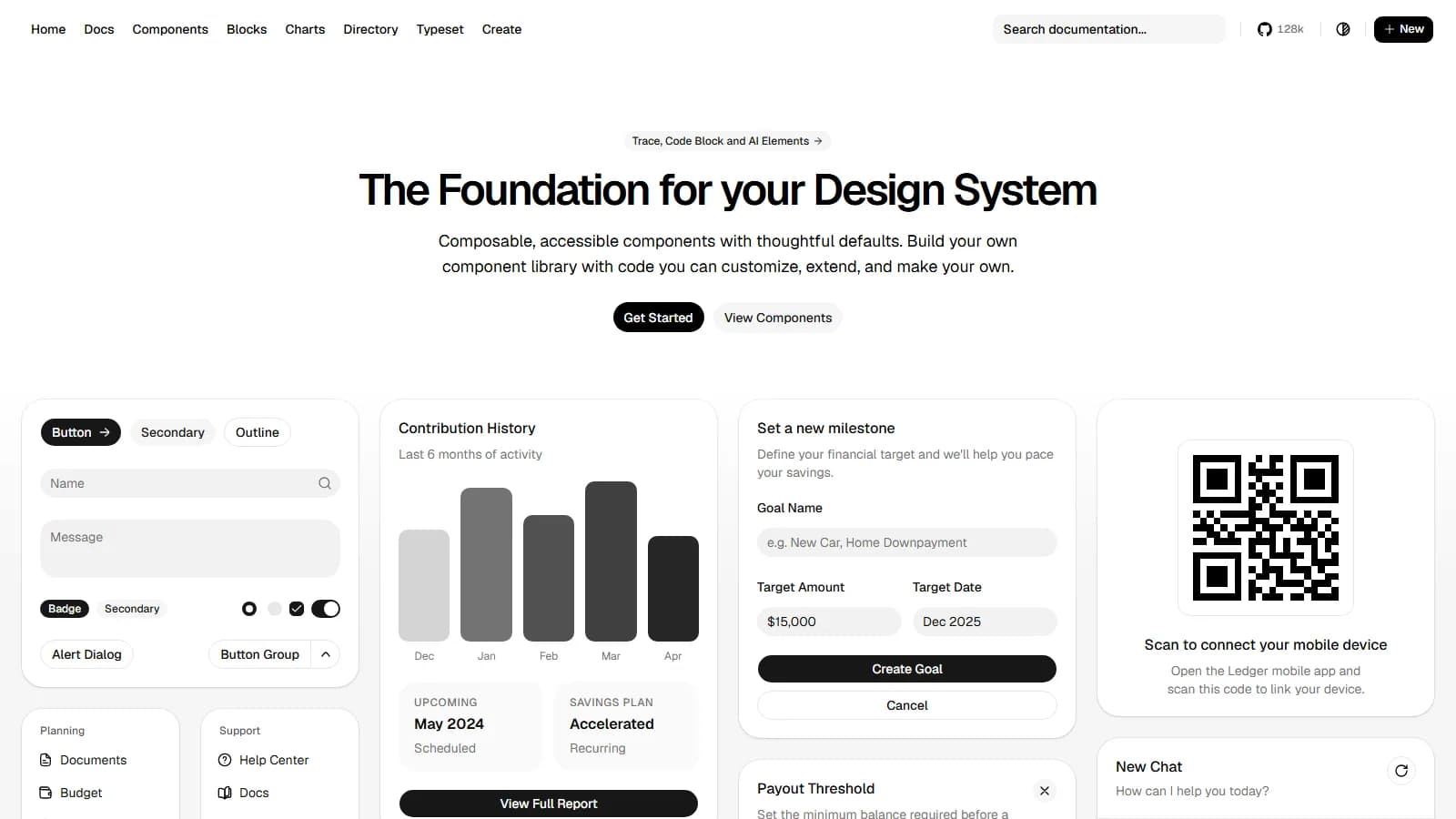
Shadcnblocks is a curated code library built on top of shadcn/ui, Radix UI, and Tailwind CSS, offering hundreds of responsive interface blocks from marketing landing pages to complex SaaS dashboards. Rather than serving components through an npm package, it injects source code directly into your repository tree, ensuring full code ownership and eliminating external runtime dependencies.
Engineering Summary
Component distribution bypasses package registries in favor of source injection via the shadcn CLI namespace. Adhering to Radix UI accessibility standards and Tailwind CSS design tokens, it integrates smoothly into enterprise design systems while avoiding third-party library lock-in.
Why It Surfaced: The Real Production Problem
In scaling SaaS projects and corporate platforms, teams often hit a delivery bottleneck: atomic interface components exist, but marketing layouts, complex pricing grids, and administrative dashboards must still be engineered from scratch. Engineering squads frequently end up adopting rigid, bloated component suites or hand-coding layouts, delaying deployment milestones. Shadcnblocks closes this gap by scaling the shadcn/ui philosophy from primitive primitives (buttons, dialogs, inputs) to composite page sections. Engineers copy verified designs directly into their projects with a single terminal command, collapsing weeks of frontend assembly into hours.
Under the Hood: Architecture, Interaction, and Tech Stack
The architecture of Shadcnblocks leverages modern Astro and React static-dynamic compilation pipelines. Instead of delegating component resolution to an isolated runtime manager, it uses an Abstract Syntax Tree (AST)-based CLI that writes source files directly into your project. When building an enterprise Next.js development infrastructure, these blocks bind seamlessly to local Tailwind configurations and global CSS variables. To calculate the resource efficiency your engineering team can achieve with this modular approach, run initial metrics through our cost calculator. You can also explore our technical shadcn/ui review to understand the foundational principles behind this ecosystem.
| Evaluation Metric | Traditional / Manual Workflow | Shadcnblocks Approach |
|---|---|---|
| Dependency Management | Heavy npm bundles and runtime version conflicts | Direct source injection with zero external vendor runtime |
| Design Flexibility | Overriding library styles with '!important' selectors | Direct, granular control over standard Tailwind utilities |
| Accessibility (a11y) | Manual ARIA tagging and custom focus-ring handling | Full WAI-ARIA standards inherited through Radix UI primitives |
| Velocity | Prototyping and testing composite sections from scratch | Production-ready blocks installed in seconds via CLI |
When to Adopt and When to Reconsider in Production
Shadcnblocks serves as an ideal accelerator for fast-moving B2B SaaS startups, high-traffic marketing properties, and digital agencies operating on fixed delivery cycles. Copying source code directly into your repository preserves long-term freedom for independent customization. Conversely, attempting to integrate this library into codebases relying on CSS-in-JS, zero-Tailwind stacks, or bespoke WebGL canvas viewports introduces structural friction and unnecessary styling overhead.
Kling Digital Architectural Note
Before injecting blocks via the CLI, confirm that your project's root Tailwind color tokens and typography scale match your target brand definitions. Every newly added block will instantly inherit your visual language, driving manual layout adjustments down to near zero.