Enterprise artificial intelligence has officially crossed the chasm from experimental token consumption to rigorous financial scrutiny. The era of tokenmaxxing—the unrestrained pursuit of ever-larger context windows and model leaderboard vanity metrics—has collided with boardroom accountability. In its 2026 global benchmark report, Google Cloud and National Research Group evaluated 2,403 senior executives across the Americas, EMEA, and APAC, synthesizing nearly 300,000 data points to establish a definitive reality check: the future of enterprise AI belongs to token efficiency and autonomous agent fleets.
### Executive Summary & Key Research Findings
- The Macro Pivot: In April 2026, global searches for "AI ROI" on YouTube officially surpassed "how to use AI", with Google Search queries for "token efficiency" surging 335% in the first half of 2026 alone.
- Financial Consensus: 86% of enterprise executives confirm that AI drives cost-efficient growth without proportional increases in operational expenditure.
- The AI ROI Leaders (Top 26%): A distinct cohort of enterprises is experiencing accelerating financial returns year-over-year, distinguished by rapid decision governance (48% vs 27%), mandatory employee AI fluency (38% vs 18%), and embedding AI into core revenue streams (48% vs 27%).
- The Power of Agents: 94% of respondents report that autonomous AI agents contribute directly to both top-line revenue expansion and bottom-line cost reduction.
- Security as the #1 Enabler: Improved security, regulatory compliance, and governance readiness (46%) rank as the single most critical factor in scaling AI from pilot to production.
1. The Macroeconomic Shift: The Death of Tokenmaxxing
During the initial generative AI boom (2023–2025), enterprise technology budgets were frequently allocated based on FOMO (fear of missing out). Organizations benchmarked models based on raw parameter size and arbitrary leaderboard rankings.
In 2026, that paradigm has collapsed under the weight of cloud compute invoices. As Oliver Parker, Vice President of AI at Google Cloud, summarizes:
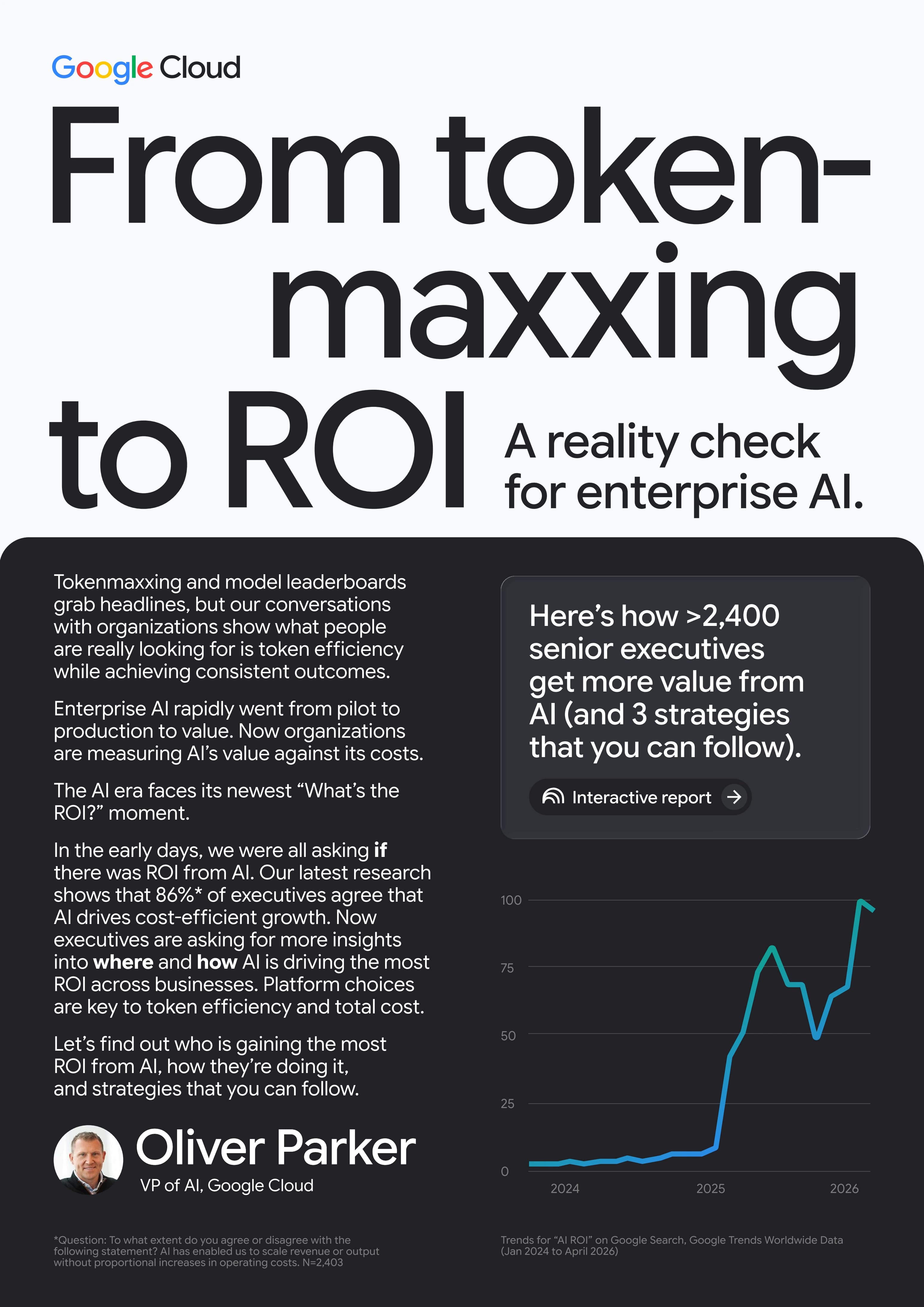
"Tokenmaxxing and model leaderboards grab headlines, but our conversations with organizations show what people are really looking for is token efficiency while achieving consistent outcomes. Enterprise AI rapidly went from pilot to production to value. Now organizations are measuring AI’s value against its costs."
Historical Search Intent Inflection (Google Trends Worldwide)
┌────────────────────────────────────────────────────────────────────────┐
│ Dec 2022:  "How to use AI" searches jump +160% in one month           │
│ Jan 2024:  "Gen AI" queries increase +800% in 12 months                │
│ Aug 2025:  "AI ROI" searches skyrocket +1,400% on Google Search        │
│ Apr 2026:  "AI ROI" officially OVERTAKES "How to use AI" on YouTube   │
│ Jun 2026:  "Token efficiency" searches surge +335% in H1 2026          │
└────────────────────────────────────────────────────────────────────────┘
The industry has decisively graduated from curious exploration to disciplined unit economics. C-level executives are demanding quantifiable return on capital invested in foundation models.
2. Profile of the Top 26%: What Sets AI ROI Leaders Apart
When examining the 2,403 surveyed global enterprises, Google Cloud identified an elite 26% cohort whose financial returns from AI initiatives are accelerating year-over-year. While 58% report steadily increasing returns and 16% report plateauing or inconsistent outcomes, this 26% group outpaces competitors across three non-negotiable operational disciplines:
┌──────────────────────────────────────────────────────────────────────────┐
│                   3 BEHAVIORS OF AI ROI LEADERS (26%)                    │
├──────────────────────────┬──────────────────────────┬────────────────────┤
│ 1. Faster Decisions      │ 2. Mandatory Fluency     │ 3. Core Embedding  │
│ 48% clear agent authority│ 38% mandatory upskilling │ 48% core process & │
│ (vs. 27% peers)          │ (vs. 18% peers)          │ revenue integration│
└──────────────────────────┴──────────────────────────┴────────────────────┘
1. High-Velocity Decision Governance
Nearly half (48%) of AI ROI Leaders describe their ownership and decision-making authority for autonomous AI initiatives as "extremely clear," compared to just 27% of other organizations. Rather than bogging down implementations in multi-department steering committees, leaders designate clear ownership lines between engineering leads, product managers, and compliance officers.
2. Mandatory, Continuous AI Fluency
38% of AI ROI Leaders have comprehensive, role-embedded AI training programs with mandatory certification, compared to only 18% of their peers. They recognize that software licenses alone do not create value; workforce capability must evolve in parallel with agent capabilities.
3. Deep Integration into Core Business Processes
While laggards deploy isolated chatbots for peripheral Q&A, 48% of AI ROI Leaders embed AI agents directly into primary transaction flows, ERP backbones, and proprietary customer-facing applications. AI is not treated as a feature—it is the operational fabric.
3. "In One Word: Agents"
When asked how AI drives quantifiable financial returns, the executive response across 2,403 global organizations was unequivocal: autonomous AI agents.
94% of respondents state that AI agents deliver measurable contributions across both cost reduction and revenue expansion. Unlike passive prompt-response models, autonomous agents possess:
- Defined Organizational Roles & Objectives: Specialized boundaries for sales qualification, technical support, inventory routing, or automated code refactoring.
- Stateful Tool Calling & API Execution: Direct, governed access to SQL databases, RESTful endpoints, CRM registries, and ERP systems.
- Agent-to-Agent Orchestration: Decomposing complex enterprise goals into multi-agent DAGs (Directed Acyclic Graphs), where specialized worker agents execute sub-tasks and report back to a supervising coordinator.
4. Production Case Studies: Realized Enterprise Value
The report highlights diverse, cross-industry deployments that demonstrate tangible business returns across Fortune 500 enterprises:
Tata Steel: Scaling an Autonomous Fleet of 300+ Agents
In heavy manufacturing, Tata Steel deployed a fleet of over 300 specialized AI agents in just nine months using Google Cloud infrastructure. These agents operate autonomously across global manufacturing plants, orchestrating supply chain logistics, predicting metallurgical anomalies, and optimizing furnace energy consumption.
Highmark Health: $27.9 Million in Annual Value
Healthcare leader Highmark Health deployed Sidekick, an internal AI assistant platform powered by Gemini models. In 2025 alone, Sidekick generated $27.9 million in verified organizational value by automating clinical research protocols, summarizing complex medical histories, and providing secure search proxies for administrative staff.
Elanco: $1.9 Million ROI in Pharmacovigilance
Global animal health company Elanco leveraged Gemini Enterprise Agent Platform to automate pharmacovigilance surveillance and customer order processing, delivering $1.9 million in audited ROI within twelve months of production deployment.
Best Buy & PayPal: Intelligent Customer Decisioning
Best Buy utilizes Gemini Enterprise to condense thousands of customer reviews into actionable buying guidance, accelerating conversion rates. Simultaneously, PayPal leverages Gemini to build an intelligent, real-time decisioning layer that powers personalized customer interactions at global scale.
5. Architectural Blueprint: Token-Efficient Agent Middleware
To achieve token efficiency in production, enterprise architectures must avoid routing every user prompt directly to expensive, high-parameter models. Modern systems implement semantic token gateways that dynamically cache responses, validate intent, and tier requests across specialized model sizes.
import { GoogleGenAI } from "@google/genai";
interface TokenBudgetGuard {
  maxTokensPerRequest: number;
  costThresholdUsd: number;
}
export class EnterpriseAgentRouter {
  private ai: GoogleGenAI;
  private tokenCache: Map<string, string>;
  constructor(apiKey: string) {
    this.ai = new GoogleGenAI({ apiKey });
    this.tokenCache = new Map();
  }
  /**
   * Routes query to the most token-efficient model based on complexity scoring
   */
  async executeIntent(query: string, userTier: "ENTERPRISE" | "STANDARD"): Promise<string> {
    const cacheKey = `intent:${query.trim().toLowerCase()}`;
    if (this.tokenCache.has(cacheKey)) {
      return this.tokenCache.get(cacheKey)!; // 0 tokens consumed
    }
    // Evaluate query complexity (Token-efficient routing)
    const isHighComplexity = query.length > 300 || /architect|compliance|reconcile|audit/i.test(query);
    const targetModel = isHighComplexity
      ? "gemini-1.5-pro"      // Complex multi-step reasoning
      : "gemini-2.0-flash";    // High-velocity token efficiency
    const response = await this.ai.models.generateContent({
      model: targetModel,
      contents: query,
      config: {
        temperature: 0.1, // Deterministic corporate output
        maxOutputTokens: 1024,
      },
    });
    const result = response.text || "";
    this.tokenCache.set(cacheKey, result);
    return result;
  }
}
6. Top 10 Scaling Enablers for Enterprise AI
When 2,001 executives evaluated which capabilities most enabled their transition from proof-of-concept (PoC) to production scale, their responses highlighted the foundational role of security and systems engineering:
| Rank | Scaling Enabler | % of Executives |
|---|---|---|
| 1 | Improved security, compliance & regulatory readiness | 46% |
| 2 | Redesign of workflows to embed AI into core processes | 43% |
| 3 | Workforce training and organizational change management | 41% |
| 4 | Cloud and underlying infrastructure modernization | 41% |
| 5 | Centralized AI operating model (Center of Excellence / Hub) | 40% |
| 6 | Clear executive sponsorship and C-suite accountability | 39% |
| 7 | Vendor strategy optimization & reducing tool sprawl | 39% |
| 8 | Modernized, unified data infrastructure | 37% |
| 9 | Dedicated ROI and value-tracking governance framework | 37% |
| 10 | Standardized platform consolidation | 36% |
7. Official Whitepaper & PDF Catalog Resource
To inspect the primary charts, statistical methodologies, and complete survey distributions across all 2,403 respondents, access the official 10-page report directly from our library:
### Download Official Executive Study
Access the complete 10-page enterprise report published by Google Cloud & National Research Group:
Download Google Cloud Enterprise AI ROI Report 2026 (PDF)
Explore our full repository of digital engineering whitepapers in the Kling Digital E-Catalog.
8. Conclusion: Moving from Discussion to Execution
As 97% of surveyed enterprises plan to increase or maintain their AI budgets over the next fiscal year, the line separating market leaders from trailing competitors will not be drawn by how many tokens they consume. It will be determined by how efficiently they turn machine intelligence into corporate velocity.
At Kling Digital, we architect enterprise software, multi-tenant cloud platforms, and custom AI agent workflows built on rigorous security boundaries and token-efficient design. Contact our software architecture team to discuss how to implement high-ROI AI systems across your business operations.