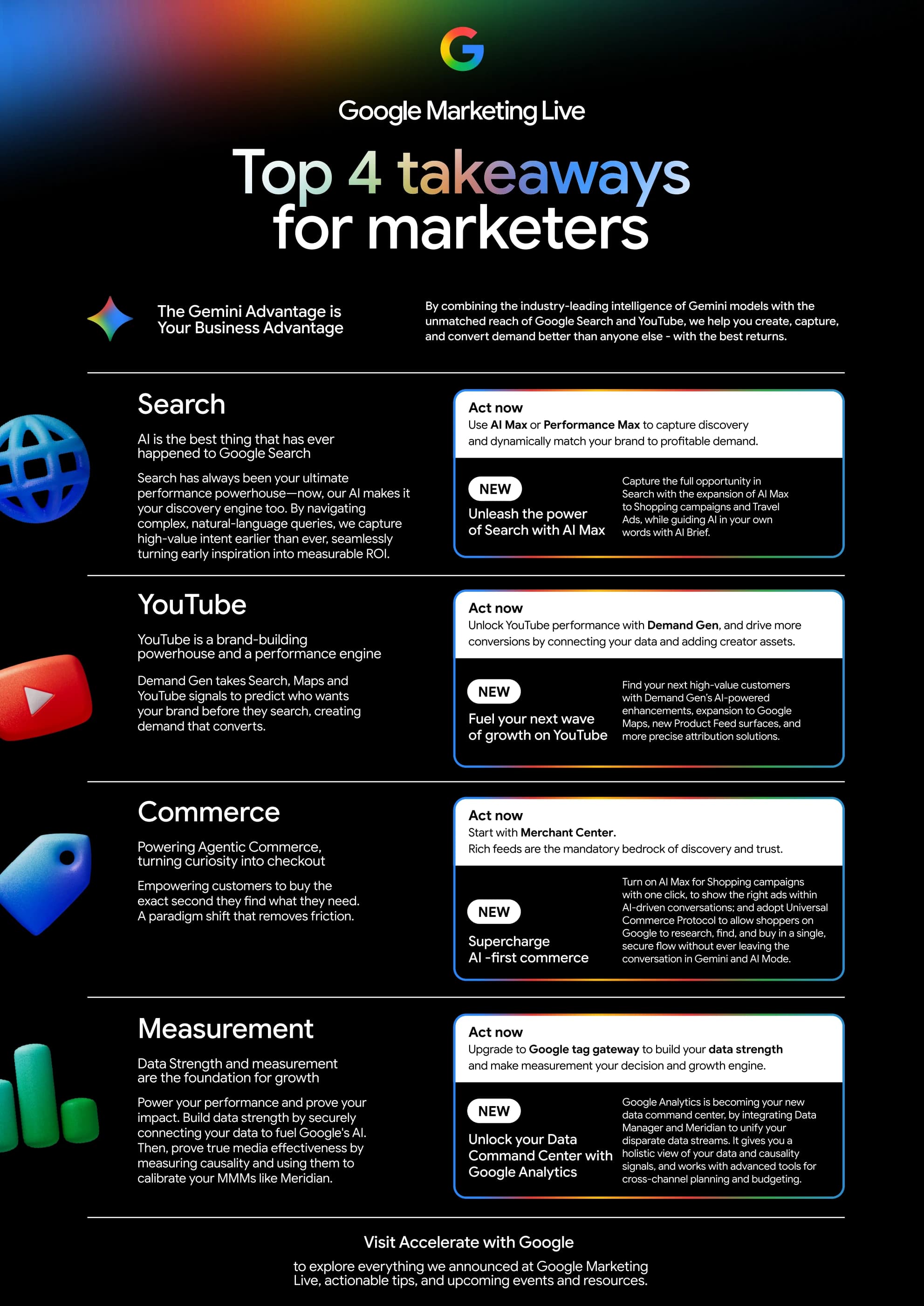
Google Marketing Live (GML) EMEA 2026 marks a decisive architectural inflection point for digital enterprises: generative artificial intelligence is no longer an auxiliary ad-copy optimizer, but the core engine powering the entire customer demand lifecycle. By uniting Gemini foundation models with the unmatched query surfaces of Google Search and YouTube, Google has re-architected digital marketing into a four-pillar framework designed to create, capture, and convert intent with unprecedented return on investment (ROI).
### Key Strategic Takeaways
- Search Evolves from Query Matching to Intent Discovery: AI Max and AI Brief expand beyond keyword bidding into complex natural-language conversational queries, capturing high-intent demand at the earliest research phase.
- Cross-Surface Demand Generation: YouTube Demand Gen integrates Search and Google Maps signals to predict user intent before explicit searches occur, incorporating rich product feeds and dynamic creator assets.
- Agentic Commerce via UCP: The rollout of the Universal Commerce Protocol (UCP) allows shoppers in Gemini and AI Mode to research, configure, and execute checkouts in a single conversational session without navigating away.
- Causality-Driven Measurement: Transition from fragmented third-party cookies to the Google Tag Gateway, unifying multi-channel signals through open-source Marketing Mix Modeling (Meridian) and Google Analytics as an enterprise data command center.
1. Search Re-Engineered: From Keyword Harvest to Discovery Powerhouse
For two decades, search engine marketing functioned as a reactive capture mechanism: a user submitted an explicit query, and advertisers bid on corresponding keyword match types. At GML EMEA 2026, Google demonstrated that Search is now an active discovery engine.
Through the nationwide deployment of AI Max across standard Search and Shopping campaigns, Gemini models synthesize complex, multi-clause natural language queries (e.g., "Find an enterprise multi-tenant headless CMS supporting regional data sovereignty and PostgreSQL 16"). Rather than forcing users to dissect their needs into rigid keyword fragments, the search engine processes the holistic technical context.
The Role of AI Brief
Advertisers are no longer constrained by rigid negative keyword lists and bid multipliers. With AI Brief, enterprise growth teams describe their commercial guardrails, target audience thresholds, and value propositions in plain, expressive language. The Gemini inference layer interprets these qualitative instructions, matching brand capabilities directly to profitable, low-competition long-tail queries.
[User Complex Natural Language Query]
                 │
                 ▼
     [Gemini Query Reasoning]
                 │
       ┌─────────┴─────────┐
       ▼                   ▼
[Semantic Intent]   [Commercial Entity Graph]
       │                   │
       └─────────┬─────────┘
                 ▼
   [AI Brief Guardrails & Bid Optimization]
                 │
                 ▼
[High-Conversion Dynamic Landing Surface]
2. YouTube & Cross-Surface Performance: Predictive Intent
YouTube has solidified its dual identity as both a top-of-funnel brand-building powerhouse and a high-velocity direct-response conversion engine. The cornerstone of this shift is the expansion of Demand Gen.
By aggregating multimodal signals across Google Search, YouTube engagement patterns, and now Google Maps geospatial telemetry, Demand Gen algorithms predict consumer and B2B purchase cycles prior to active navigational queries.
Key product enhancements announced at GML EMEA include:
- Google Maps Surface Expansion: Local and regional intent now seamlessly blends with video ads, prompting nearby physical visits or regional service engagements directly from discovery feeds.
- Dynamic Product Feeds: Video ad units dynamically pull localized inventory, price points, and real-time availability from Merchant Center feeds.
- Creator Asset Integration: Brands can ingest authorized creator assets directly into algorithmic campaign pipelines, combining third-party social proof with automated bidding intelligence.
- Multi-Touch Attribution Refinements: Replacing blunt last-click models with data-driven attribution that accurately credits initial video impressions for subsequent cross-device conversions.
3. Agentic Commerce: Turning Curiosity into Frictionless Checkout
The most disruptive disclosure of GML EMEA 2026 is Agentic Commerce. Traditional e-commerce UX relies on a fragmented funnel: discovery ad -> external landing page -> cart -> account login -> checkout form. Every intermediate transition introduces cognitive load and drop-off latency.
Google is dismantling this friction through the Universal Commerce Protocol (UCP), natively embedded into Gemini and Google Search AI Mode.
{
  "@context": "https://schema.org",
  "@type": "OrderAction",
  "agent": {
    "@type": "SoftwareApplication",
    "name": "Gemini Commerce Agent"
  },
  "protocol": "UniversalCommerceProtocol/1.0",
  "transaction": {
    "sessionId": "ucp_sess_947024c9",
    "merchantId": "kling-digital-enterprise",
    "sku": "KD-CUSTOM-SAAS-V4",
    "currency": "USD",
    "price": 4900.00,
    "paymentMethod": "GooglePayInstant",
    "executionMode": "IN_CONVERSATION_ONE_CLICK"
  }
}
Under this protocol, Merchant Center rich product feeds serve as the mandatory foundation of trust and discovery. When a user consults Gemini regarding software architectures or commercial hardware, the AI agent evaluates verified product specifications, confirms real-time stock and SLAs, and orchestrates the purchase directly inside the conversational window using biometric authorization (Google Pay). The customer never departs the dialogue.
For modern digital agencies and enterprise software providers, maintaining structured, machine-crawlable data catalogs is no longer optional—it is the prerequisite for participating in autonomous machine-mediated commerce. Explore our bespoke Web Design & Architecture Services to discover how we engineer platforms ready for the agentic web.
4. Measurement & Data Strength: Google Tag Gateway & Meridian MMM
Privacy-enhancing technologies, cookie deprecation, and cross-platform fragmentation have rendered legacy client-side tracking obsolete. GML EMEA establishes Data Strength as the primary competitive moat for sustainable enterprise growth.
The Google Tag Gateway
Google introduced the Tag Gateway, a robust server-side proxy boundary that centralizes telemetry collection. Instead of exposing brittle client-side tracking scripts to browser ad blockers and network failures, first-party data is ingested securely through server endpoints, ensuring cryptographic data integrity and compliance with strict privacy regulations (GDPR, KVKK).
Google Analytics as an Enterprise Data Command Center
Google Analytics is elevated into a unified command center by directly absorbing:
- Data Manager: A centralized data routing hub that connects customer lifetime value (LTV) records, offline ERP transactions, and CRM deal stages directly to Google AI bidding models.
- Meridian (Open-Source Marketing Mix Modeling): Moving beyond fragile correlation, Meridian evaluates true marketing causality. By combining Bayesian statistical models with first-party signals, Meridian allows finance and marketing executives to model budget scenarios, measure genuine incremental lift, and optimize cross-channel capital allocation.
5. Architectural Comparison: Legacy Digital Marketing vs. GML 2026
The structural differences between traditional marketing funnels and Google's agentic marketing stack highlight significant shifts in engineering and operational overhead:
| Dimension | Legacy Funnel (2020–2024) | GML 2026 Agentic Architecture |
|---|---|---|
| Search Paradigm | Exact/Phrase keyword auctions; negative lists | Natural-language intent via AI Max & AI Brief |
| Checkout Workflow | 5-step redirect funnel (Ad → Site → Cart → Gateway) | Zero-redirect conversational checkout via UCP |
| Cross-Surface Feeds | Static text headlines with manual URL parameters | Dynamic multi-surface feeds across Search, Maps & YouTube |
| Measurement Model | Cookie-based last-click attribution | Server-side Tag Gateway + Meridian Causality MMM |
| Data Governance | Uncoordinated client-side pixels | First-party Data Manager with encrypted edge hashing |
| Conversion Velocity | Days to weeks (prolonged consideration) | Real-time conversational research to instant transaction |
6. Official Whitepaper & Technical Catalog Access
To review the primary findings and technical release notes directly from Google EMEA's executive briefing, download the complete whitepaper from our corporate PDF catalog:
### Download Official Executive Briefing
Access the complete 1-page executive takeaway document published at Google Marketing Live EMEA:
Download GML EMEA Top 4 Takeaways Whitepaper (PDF)
You can also browse our full repository of digital engineering resources and service frameworks in the Kling Digital E-Catalog.
7. Strategic Synthesis for Enterprise Decision-Makers
The mandate from GML EMEA 2026 is clear: competitive advantage belongs to organizations that treat marketing as an integrated engineering discipline. By preparing product feeds for Universal Commerce Protocol, deploying server-side measurement with Tag Gateway, and commanding natural-language search via AI Max, forward-looking enterprises can capture market share while legacy competitors remain trapped in obsolete keyword bidding cycles.
If your organization is looking to modernize its digital commerce infrastructure, deploy agentic search capabilities, or architect high-performance custom platforms, reach out to our engineering team for a strategic consultation.