

Executive Summary & Architectural Takeaways
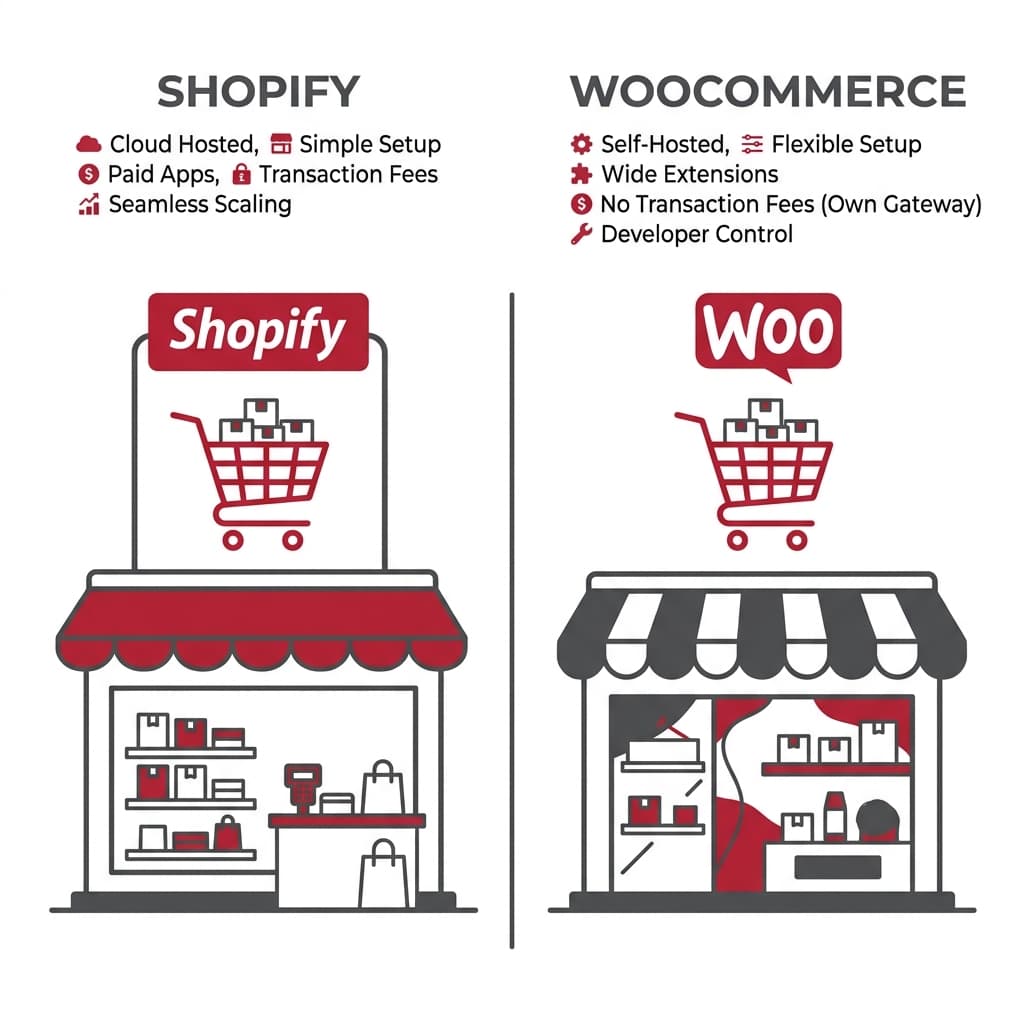
- Infrastructure Paradigm: Shopify is a closed, multi-tenant managed SaaS ecosystem that abstracts server administration, whereas WooCommerce is an open-source commerce engine offering 100% ownership over your database schema (HPOS), caching layers, and application code.
- Unit Economics & Gateway Penalties: Outside Shopify Payments regions (or when integrating specialized local PSPs), Shopify levies an additional 0.5% to 2.0% third-party transaction penalty. WooCommerce charges 0% platform commission across all global and regional payment gateways.
- Technical SEO & URL Authority: Shopify enforces rigid
/collections/and/products/path prefixes, while WooCommerce grants complete control over permalink hierarchies, crawl budget management for faceted navigation, and programmatic JSON-LD schema graphs.
Selecting an e-commerce platform is far more than choosing a visual template or admin dashboard; it is a foundational systems engineering decision that dictates your unit economics, search engine crawl budget efficiency, ERP/CRM synchronization latency, and checkout conversion resilience over the next five years. In 2026, the Shopify vs WooCommerce debate represents two distinct architectural philosophies: managed multi-tenant SaaS convenience versus composable, open-source infrastructure sovereignty.
In this comprehensive engineering guide, we move beyond surface-level feature checklists to evaluate both platforms across database concurrency, Core Web Vitals (LCP, INP, TTFB), payment gateway unit economics, international technical SEO, and 3-year Total Cost of Ownership (TCO).
1. Architectural Foundations: Multi-Tenant SaaS (Shopify) vs Open-Source HPOS (WooCommerce)
The long-term scalability of an online store depends on its underlying data model and runtime execution environment.
Shopify: Closed-Source Multi-Tenant Cloud Architecture
Shopify operates as a fully hosted, multi-tenant SaaS platform that bundles cloud hosting, CDN distribution, TLS termination, PCI-DSS Level 1 compliance, and database sharding into a unified subscription. Its presentation layer relies on the proprietary Liquid templating engine, or React-based Hydrogen deployed on Oxygen edge workers for headless implementations.
- Architectural Strength: Infrastructure provisioning, zero-downtime platform updates, and automatic burst scaling during flash sales are entirely managed by Shopify's site reliability engineering team.
- Architectural Constraint: You have zero access to the underlying database indexes, SQL query execution plans, or web server configuration (Nginx/Varnish rules). Checkout modifications are strictly sandboxed within Checkout Extensibility UI extensions, and advanced checkout logic requires upgrading to Shopify Plus ($2,300+/month).
WooCommerce: Full Data Sovereignty & High-Performance Order Storage (HPOS)
WooCommerce is an open-source commerce engine built on WordPress that has fundamentally modernized its database layer through High-Performance Order Storage (HPOS). Rather than storing orders in legacy generic content tables (wp_posts and wp_postmeta), HPOS utilizes dedicated, tightly indexed relational tables (wp_wc_orders, wp_wc_order_addresses, wp_wc_order_operational_data, and wp_wc_orders_meta).
- Architectural Strength: Businesses retain 100% ownership of the application codebase, MySQL/MariaDB composite indexes, Redis object cache pipelines, and server topology. Custom B2B tiered pricing engines, multi-warehouse inventory routing, and real-time ERP webhooks execute natively without external API rate-limit throttling.
- Architectural Responsibility: Achieving enterprise-grade performance requires replacing cheap shared hosting with isolated cloud compute (AWS, GCP, Hetzner, or DigitalOcean), Nginx FastCGI page caching, PHP 8.3+ with OPcache JIT, Redis object caching, and edge CDN routing.
2. Deep Technical Comparison Matrix (2026)
The following matrix evaluates Shopify and WooCommerce across 12 engineering, SEO, and financial dimensions:
| Architectural Dimension | Shopify (Standard / Advanced / Plus) | WooCommerce (Enterprise Cloud + HPOS Stack) |
|---|---|---|
| Hosting & Runtime Model | Fully managed, closed-source multi-tenant SaaS | Open-source, self-hosted cloud with full root/stack control |
| Database Schema | Abstracted proprietary storage; no direct SQL/index access | Dedicated HPOS relational tables (wp_wc_orders) with custom indexing |
| Checkout Extensibility | Sandboxed UI extensions (Full customization requires Plus) | Unlimited customization (One-page, B2B VAT/Tax ID validation, custom flows) |
| Platform Transaction Fees | 0.5% – 2.0% penalty when using third-party payment gateways | 0% Platform Fee (You only pay your payment processor's native rate) |
| Global & Local Payment Gateways | Restricted to supported integrations; penalty outside Shopify Payments | Universal support (Stripe, Adyen, PayPal, Klarna, iyzico, PayTR) with zero surcharge |
| URL & Permalink Structure | Rigid (/collections/, /products/, /pages/ cannot be removed) | 100% customizable flat or hierarchical URL taxonomy |
| Technical SEO & Crawl Budget | Opinionated robots.txt and rigid tag/filter URL generation | Full control over robots.txt, canonical headers, and faceted indexation rules |
| Structured Data (Schema.org) | Theme/app-dependent; frequent duplicate schema graph collisions | Programmatic JSON-LD (Product, OfferShippingDetails, MerchantReturnPolicy) |
| API Rate Limits | Governed by GraphQL cost points / REST leaky bucket limits | Determined solely by your server capacity; zero internal throttling |
| Multi-Currency & Internationalization | Shopify Markets (Subfolders/domains, tied to payment rules) | Native multi-network or WPML/Polylang Pro with full hreflang precision |
| Core Web Vitals (LCP / INP / TTFB) | Fast base CDN, but severe main-thread JS bloat from third-party apps | <100ms TTFB and minimal JS payload when built with atomic components + Redis |
| Vendor Lock-in & Portability | High lock-in; Liquid themes and proprietary app data cannot be exported | Zero lock-in; 100% of code, customer records, and order history belong to you |
3. Database Concurrency, Caching & Core Web Vitals Engineering
Search visibility and checkout conversion rates are heavily influenced by Largest Contentful Paint (LCP < 2.5s), Interaction to Next Paint (INP < 200ms), and Time to First Byte (TTFB < 200ms). Both platforms exhibit distinct performance profiles under load.
The "App Bloat" Problem and Client-Side INP Degradation on Shopify
Because Shopify serves storefront pages through a globally distributed Cloudflare CDN, a barebones theme achieves rapid initial TTFB. However, production stores rarely stay barebones. To add multi-step product filtering, B2B wholesale logic, subscription billing, review schemas, upsell drawers, and regional shipping calculators, merchants typically install 15 to 30 third-party apps from the Shopify App Store.
Each app injects external JavaScript bundles and DOM observers into the client browser. While the HTML document arrives quickly, the browser's main thread becomes blocked parsing and executing third-party scripts, causing INP (Interaction to Next Paint) to degrade past 350–500ms on mobile devices. Because developers cannot merge or server-render third-party app logic inside Shopify's closed runtime, mitigating app bloat often forces an expensive migration to a custom headless storefront.
Engineering Sub-100ms TTFB on WooCommerce with HPOS & Redis
The misconception that WooCommerce is slow stems from running legacy WordPress installations on $5 shared hosting with bloated visual page builders. When architected according to modern cloud engineering standards, WooCommerce outperforms multi-tenant SaaS platforms:
# Enterprise WooCommerce Nginx FastCGI + Edge Bypass Configuration
set $skip_cache 0;
# Bypass static cache for transactional endpoints
if ($request_uri ~* "/(cart|checkout|my-account|wc-api|addons)/") {
    set $skip_cache 1;
}
# Dynamically route active shopping sessions with populated carts
if ($http_cookie ~* "woocommerce_items_in_cart|wp_woocommerce_session_") {
    set $skip_cache 1;
}- HPOS Query Efficiency: By isolating order records into
wp_wc_orderswith dedicated composite indexes, order creation throughput increases by up to 5x and admin/API filtering scales effortlessly to millions of orders. - In-Memory Redis Object Caching: Product catalog queries, tax calculations, and session states are served directly from RAM via Redis, eliminating repetitive database reads.
- Clean Frontend Architecture: Pairing WooCommerce with lightweight block templates or a headless Next.js storefront via custom software development eliminates third-party script bloat entirely, sustaining sub-100ms TTFB and sub-120ms INP scores.
4. Payment Gateways, Unit Economics & 3-Year TCO Breakdown
The true cost of an e-commerce platform is not its entry-level subscription price; it is the cumulative 36-month expenditure across base plans, mandatory app subscriptions, and percentage-based transaction penalties on Gross Merchandise Value (GMV).
Hidden Cost Alert: Third-Party Payment Gateway Surcharges
If your business operates in a region where Shopify Payments is unavailable, or if you prefer direct contracts with regional payment processors (such as iyzico, PayTR, Adyen, or local bank POS gateways) for better installment rates, Shopify charges an additional platform penalty of 2.0% (Basic), 1.0% (Shopify/Grow), or 0.6% (Advanced) on every single transaction.
Financial Model: Store Generating $100,000 Monthly GMV ($1.2M Annual GMV)
- Shopify Cost Structure:
- Base Platform Subscription (Shopify / Advanced): $105 – $399 / month
- Third-Party Payment Gateway Surcharge (at 1.0% average): $1,000 / month ($12,000 / year)
- Paid App Stack (Advanced filtering, SEO schema, B2B rules, loyalty, multi-language): $300 – $700 / month
- Total Annual Platform + App + Penalty Cost: ~$17,000 – $25,000 / year (Excluding standard credit card processing fees!)
- WooCommerce Cost Structure:
- Core Software License & Platform Transaction Surcharge: $0 (0% platform commission)
- Managed Cloud Infrastructure (Dedicated vCPU, NVMe SSD, Redis, Automated Backups, WAF): $80 – $160 / month
- Premium Plugin & Maintenance Licenses (Fixed annual cost): ~$800 – $1,500 / year
- Total Annual Infrastructure Cost: ~$1,800 – $3,400 / year
Over a 36-month lifecycle, a growing brand processing $100k/month retains $45,000 to $65,000 in direct net profit on WooCommerce—capital that can be reinvested into inventory, engineering, or customer acquisition.
5. Technical SEO, URL Hierarchy & Organic Acquisition Power
As paid acquisition costs (CPA/CAC) continue rising across Meta and Google Ads in 2026, organic search equity is the primary driver of sustainable e-commerce margin. From an enterprise SEO and digital marketing perspective, WooCommerce provides critical structural advantages:
1. URL Taxonomy & Canonical Purity
Shopify hardcodes /collections/, /products/, and /pages/ into every URL. Furthermore, linking to products within collection templates frequently generates duplicate /collections/{category}/products/{product} URLs that dilute internal PageRank and waste Googlebot crawl budget unless themes are manually patched. WooCommerce gives architects complete control over permalink routing, enabling clean, semantic URL hierarchies tailored to search intent.
2. Programmatic Faceted Navigation Control
In large catalogs, attribute filters (size, color, material, brand, technical specs) represent high-converting long-tail search queries. On WooCommerce, engineers can selectively transform high-volume filter combinations into indexable, static-cached SEO landing pages with custom H1s, canonical tags, and editorial copy—while strictly blocking low-value parameter permutations via dynamic X-Robots-Tag headers. Shopify's native tag and storefront filtering system offers far less granular indexation governance.
3. Unified JSON-LD Schema Graphs
Winning Google Merchant listings and AI Search (GEO) citations requires interconnected Product, AggregateOffer, OfferShippingDetails, MerchantReturnPolicy, and FAQPage schemas. WooCommerce allows direct server-side injection of unified JSON-LD graphs populated from custom database attributes (GTIN, MPN, brand, stock velocity) without relying on conflicting third-party SEO apps.
6. Decision Framework: Which Platform Should You Choose in 2026?
Architectural Decision Rule
Do not choose your commerce platform based solely on day-one setup speed; architect for your target GMV, ERP integration requirements, and organic traffic strategy 24 months from now.
Choose Shopify If:
- You have no internal technical resources or agency partner and need to launch a simple direct-to-consumer (DTC) catalog or MVP within 48 hours,
- Your business operates exclusively in a country where Shopify Payments is natively supported, avoiding third-party gateway penalties,
- Your catalog follows standard retail patterns without complex B2B pricing tiers, custom checkout compliance fields, or custom URL requirements.
Choose WooCommerce If:
- Technical SEO, content commerce, and organic search dominance are core pillars of your growth strategy,
- You want to integrate global and regional payment gateways (Stripe, PayPal, iyzico, PayTR, Adyen) with 0% additional platform transaction fees,
- You require custom B2B wholesale portals, multi-warehouse ERP synchronization, custom checkout validation, or bespoke product configurators,
- You demand 100% data ownership, zero vendor lock-in, and predictable infrastructure costs as your GMV scales.
At Kling Digital, our engineering team designs and builds high-conversion, HPOS-optimized WooCommerce and headless commerce architectures paired with enterprise web design services. Whether you are migrating away from Shopify's escalating transaction fees with a zero-downtime 301 redirect and schema preservation strategy, or launching a new global storefront, contact our architects to build a scalable commerce foundation.