
In many enterprise organizations, Search Engine Optimization (SEO) and Pay-Per-Click (PPC) teams operate in complete isolation—often across separate internal departments or rival external agencies. The organic growth team pursues rankings for high-volume keywords over multi-month horizons, while the paid media team optimizes auction bids for immediate conversions and short-term Return on Ad Spend (ROAS). This organizational and technical fragmentation is a foundational architectural flaw that drains marketing budgets, inflates Customer Acquisition Cost (CAC), and caps long-term revenue growth.
To dominate the search engine results page (SERP) and maximize total marketing efficiency, businesses must engineer search as a unified ecosystem. When you align paid and organic strategies at the data layer, you stop paying twice for clicks you would have captured organically and start capturing high-intent market share that your competitors miss due to channel silos.
This comprehensive technical framework details how to integrate PPC and SEO across the buyer's journey to drive incremental revenue, lower blended CAC, leverage Core Web Vitals to reduce Google Ads CPCs, and establish multi-touch attribution.
The Economics of Integration: Why Siloed Search Systems Fail
The primary rationale for unifying search channels is financial and algorithmic efficiency. When SEO and PPC teams fail to share a common data layer, two destructive scenarios inevitably emerge:
- SERP Cannibalization: You pay premium Cost-Per-Click (CPC) rates for branded or low-competition queries where your domain already holds the #1 organic position and faces zero competitor ad pressure—effectively buying traffic you would have received for free.
- Strategic Visibility Gaps: Competitive, high-intent commercial keywords are deferred by SEO because ranking takes six to twelve months, while PPC excludes top- and middle-of-funnel (TOFU/MOFU) informational queries because they fail to convert on the first click.
A unified search architecture balances immediate traffic liquidity (PPC) with long-term compounding asset creation (SEO) through integrated digital marketing services, optimizing toward a single north-star metric: Total Search ROI.
Incrementality Testing and SERP Domination
Not every overlapping keyword represents cannibalization. On highly competitive commercial queries, appearing simultaneously in both paid ads and top organic results (Dual SERP Listing) dominates the visual viewport. Search telemetry consistently demonstrates that holding both the #1 organic position and a top paid ad slot increases total click-through rate (CTR) by 25% to 35% compared to an isolated organic listing.
Conversely, for queries where you rank #1 organically with zero competitor ads present, teams must run structured incrementality tests using the Google Ads Paid & Organic Report. If pausing paid ads on specific branded or informational clusters shows that organic clicks recover more than 85% of the lost paid volume, that budget should be immediately reallocated to mid- and bottom-funnel generic queries where organic visibility is still maturing.
The Full-Funnel Mapping Framework
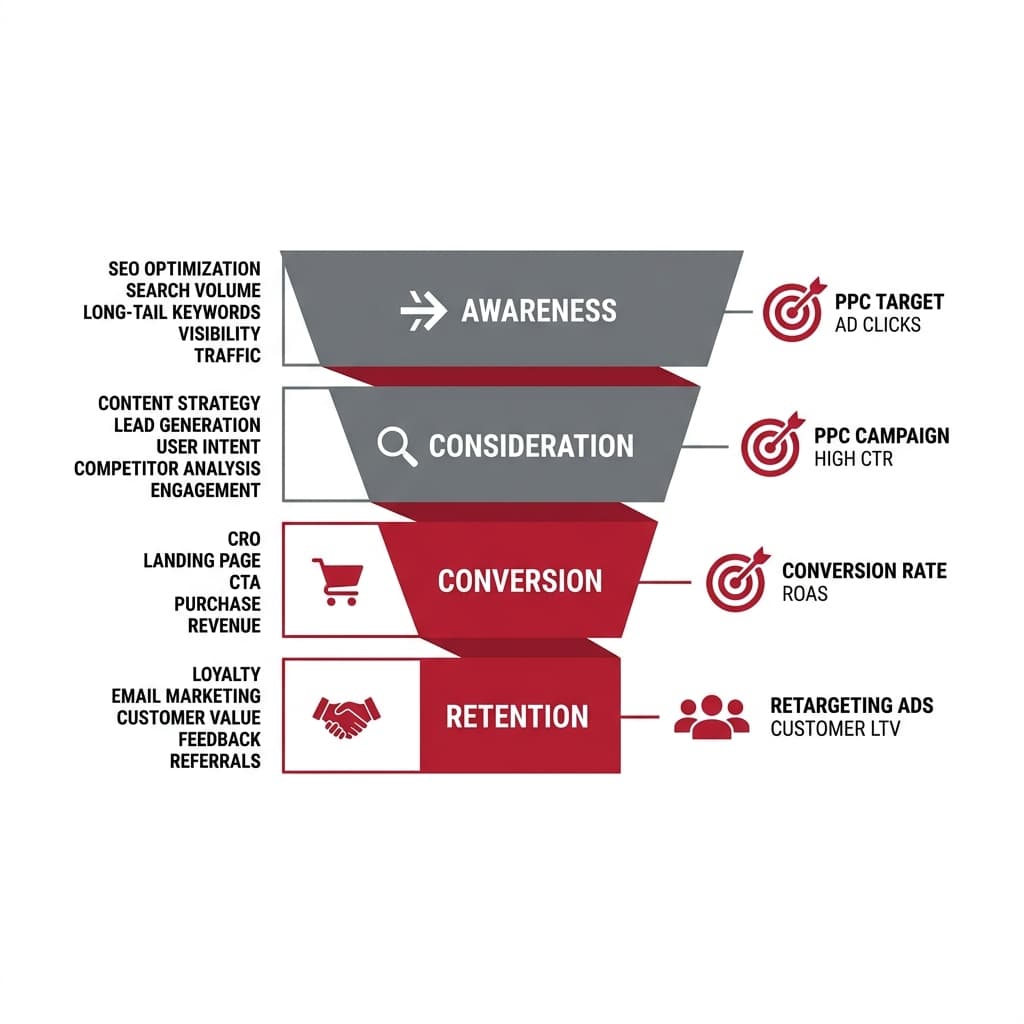
Successful alignment requires mapping explicit channel responsibilities to each stage of the buyer's journey based on search intent, conversion probability, and click economics.
1. Top of the Funnel (TOFU - Awareness): SEO's Stronghold & Paid Discovery
At the awareness stage, search volume is high, but immediate purchasing intent is low. Users are diagnosing a technical problem or exploring architectural concepts rather than evaluating vendors. Paying continuously via PPC for informational clicks is financially unsustainable due to low first-click conversion rates. This stage is the primary domain of Search Engine Optimization (SEO).
- Data-Driven Strategy: Before investing weeks into producing an organic topic cluster, run controlled, time-boxed PPC discovery campaigns using broad-match modifiers or Dynamic Search Ads (DSA) to identify the exact long-tail questions users ask and which value propositions generate the highest engagement.
- Architectural Implementation: Transform validated, high-CTR queries from the Google Ads Search Terms Report into authoritative technical guides and educational hubs that rank organically. Once organic rankings reach the top three positions, turn off direct cold PPC spend on those informational terms and rely solely on first-party audience capture for low-cost remarketing sequences.
2. Middle of the Funnel (MOFU - Consideration): The Hybrid Intervention Zone
In the consideration stage, prospects are actively comparing methodologies, technical specifications, and service providers. The SERP is heavily contested by review aggregators, industry directories, and direct competitors.
- PPC Role: Bid strategically on competitor brand terms, "best [solution] alternatives," "[service] pricing models," and category comparison queries. Crucially, use PPC to bridge the visibility gap on high-value MOFU keywords where your organic pages are currently stuck on page two or three.
- SEO Task: Engineer deep comparison matrices, interactive ROI calculators, technical case studies, and implementation blueprints designed to capture organic authority.
As your organic comparison and solution pages climb into the top three organic positions, you can progressively tighten PPC target CPA (tCPA) or target ROAS thresholds—lowering your blended acquisition cost while maintaining uninterrupted SERP presence.
3. Bottom of the Funnel (BOFU - Conversion): Paid Dominance & Post-Click CRO
When search intent is explicitly transactional, invisibility equals lost revenue. Even if your site holds the #1 organic ranking, mobile viewports are completely occupied above the fold by sponsored search ads, local service packs, and structured sitelink extensions.
However, winning the auction click is only half the equation. The post-click experience dictates both your conversion rate and your future ad auction pricing. Capturing maximum ROI at the bottom of the funnel requires high-velocity landing pages and enterprise Web Design Services that unify technical stability, message match, and Conversion Rate Optimization (CRO).
Data Sharing: The "Keyword Arbitrage" Methodology
One of the highest-leverage engineering practices within this framework is utilizing PPC as a real-time validation sandbox for SEO investments. Building organic authority for a competitive keyword cluster takes months of content engineering and internal linking; discovering afterward that the keyword drives zero qualified pipeline is an expensive failure. PPC delivers statistically significant conversion telemetry within days.
| Performance Metric | Siloed Search Approach | Integrated Full-Funnel Approach |
|---|---|---|
| Keyword Validation | Relies on third-party search volume estimates and guesswork. | Driven by proven conversion rate and revenue telemetry from Google Ads Search Terms reports. |
| SERP Real Estate | Single listing (Either Paid or Organic in isolation). | Dual listing (Paid + Organic on high-intent terms) driving up to 30% higher combined CTR. |
| Budget & Bid Efficiency | Static, aggressive bidding across all keywords regardless of organic rank. | Dynamic bid tapering on uncontested #1 organic terms; capital redeployed to page-two organic gaps. |
| Content & Meta Strategy | Based on editorial intuition or competitor mimicry. | Engineered from high-CPC queries and winning Responsive Search Ad (RSA) copy variations. |
| Blended CAC Trajectory | Rises linearly with auction inflation and competitor bidding. | Decreases compoundly over time as validated organic assets take over traffic generation. |
Transferring RSA Copy Telemetry to Organic Meta Tags
Improving organic click-through rate (CTR) is the fastest way to multiply organic traffic without building a single new backlink. Instead of guessing which title tags and meta description hooks will resonate, SEO engineers should audit Google Ads Responsive Search Ads (RSA) asset performance reports. Headlines and value propositions that achieve "Best" performance ratings across tens of thousands of paid impressions should be systematically deployed into organic title tags, H1 headers, and structured FAQ snippets.
Technical Synergy: Core Web Vitals, Quality Score, and Ad Rank
The most direct financial link between technical SEO and paid search lives inside the Google Ads Quality Score algorithm. In every Google Ads auction, your Ad Rank and Actual Cost-Per-Click (CPC) are governed by three weighted components:
- Expected Click-Through Rate (CTR)
- Ad Relevance
- Landing Page Experience
Every architectural improvement executed by the technical SEO team—optimizing server response time (TTFB), eliminating render-blocking JavaScript, and passing Core Web Vitals thresholds—directly elevates the "Landing Page Experience" component of Quality Score from "Below Average" to "Above Average."
| Technical SEO & Web Vitals Metric | Target Engineering Threshold | Direct Financial Impact on Google Ads (PPC) |
|---|---|---|
| LCP (Largest Contentful Paint) | < 2.5 seconds | Slashes post-click bounce rates on mobile networks, raising Quality Score and reducing Actual CPC by 15% to 30%. |
| INP (Interaction to Next Paint) | < 200 milliseconds | Eliminates input lag on lead forms, configurators, and checkout flows, directly lifting conversion rates (CVR). |
| CLS (Cumulative Layout Shift) | < 0.1 | Prevents layout jumps during page load, preserving user trust and preventing accidental form abandonment. |
| Semantic HTML & Intent Alignment | Strict H1–H3 & Query Match | Strengthens algorithmic relevance between ad group keywords and landing page DOM content, boosting Ad Rank. |
Raising a campaign's average Quality Score from 5/10 to 8/10 or 9/10 reduces the Actual CPC required to maintain the exact same ad position by 20% to 40%. Technical SEO and frontend performance engineering are therefore direct multipliers on paid media buying power.
Multi-Touch Attribution and Unified Data Architecture
To prove the financial value of a full-funnel search framework to executive stakeholders, organizations must move beyond legacy attribution. Standard "Last-Click" attribution systematically undervalues top- and mid-funnel organic content that introduces the brand and educates the buyer, assigning 100% of the revenue credit to the final branded PPC click prior to checkout or form submission.
Transitioning to Data-Driven, Linear, or Time-Decay attribution models reveals how organic touchpoints nurture and accelerate paid conversions. For enterprise organizations with complex B2B sales cycles, out-of-the-box analytics setups are rarely sufficient. In these environments, custom software development is required to engineer unified data pipelines that join Google Search Console API data, Google Ads API click telemetry, and CRM Offline Conversion Tracking (GCLID matching). This unified business intelligence layer exposes true pipeline revenue and Customer Lifetime Value (LTV) across every combined search touchpoint.
Conclusion
The era of managing paid and organic search as isolated cost centers is over. By implementing a full-funnel engineering framework, you ensure that every dollar invested in PPC validates and accelerates your organic roadmap, while every technical SEO and content upgrade lowers your paid acquisition costs. The result is a resilient, compounding digital revenue engine that outperforms siloed competitors across every stage of the SERP.